Has the Bible Been Correctly Translated?
A response to the LDS church's claim
the Bible has not been properly translated.
by Cooper Abrams
*"All rights reserved"
|
|
Has the Bible Been Correctly Translated? A response to the LDS church's claim by Cooper Abrams |

One of the more subtle attacks on God’s word and our modern Bible is that it has been corrupted having been mistranslated, and parts of it lost. This implies that the Bible cannot be absolutely known or trusted. This infers that our beliefs in its teachings are suspect. Liberal churches and cults are casting a shadow over the Bible. Many unsuspecting and trusting members of these groups believe these statements. This causes confusion and doubts over the accuracy and authenticity of the Bible and their faith. These cunning attacks undermine the very foundation of the Gospel and biblical Christianity. The reality is these assaults are utterly and completely groundless, false, and have no basis in fact.
It is interesting that when you ask them where they learned that the Bible is untrustworthy, having portions lost and mistranslated, the response their church did or they read someone's book or article. When you ask them have they researched or have personal knowledge of this claim they reply they do not. It is obvious they have blindly placed their trust in their religious leaders, and they cannot verify their claims.
The eighth article of the Articles of Faith of The Church of Jesus Christ of Latter-day Saints states:
This official statement of the Church of Jesus Christ of Latter Days Saints is implying that the Bible has not been properly translated and cannot be trusted completely. In the words of its founder, note what Article 8 means to the LDS Church: Joseph Smith also declared, "I believe the Bible as it reads when it came from the pen of the original writers. Ignorant translators, careless transcribers, or designing and corrupt priests have committed many errors" (Translation of Prophet Joseph Smith, p. 327).
Apostle Mark E. Peterson said referring to the authenticity of our modern Bible, "Many insertions were made, some of them 'slanted' for selfish purposes, while at times deliberate falsifications and fabrications were perpetrated" (As Translated Correctly, p. 4). Apostle Orson Pratt stated:
"If it be admitted that the apostles and evangelists did write the books of the New Testament, that does not prove of itself that they were divinely inspired at the time they wrote.... Add all this imperfection to the uncertainty of the translation, and who, IN HIS RIGHT MIND could for one moment suppose the Bible in its present form to be a perfect guide? Who knows that even one verse of the Bible has escaped pollution, so as to convey the same sense now that it did in the original?" (Divine Authority of the Book of Mormon, pp. 45, 47) LDS Apostle Orson Pratt further proclaimed, "The Bible has been robbed of its plainness; many sacred books having been lost, others rejected by the Romish Church, and what few we have left, were copied and re-copied so many times, that it is admitted that almost every verse has been corrupted and mutilated to that degree that scarcely any two of them read alike" (The Seer, p. 213) What is interesting in light of their criticism of the King James Bible that their Book of Mormon has had over 6000 documented changes since the original 1830 edition. It should be noted that many of these changes changed their doctrine, yet their founder Joseph Smith speaking of of the 1830 original edition said, “I told the brethren that the Book of Mormon was the most correct of any book on earth, and the keystone of our religion, and a man would get nearer to God by abiding by its precepts, than by any other book.” (History of the Church, 4:461.) How can it be verified that the BOM has been changed? All one has to do is compare it will the latest edition.
"We believe the Bible to be the word of God as far as it is translated correctly; we also believe the Book of Mormon to be the word of God."
It is clear that the LDS church teaches that our modern Bible is corrupted having been mistranslated, parts of it lost and that that it cannot be trusted. Sincere Mormons trusting that their church is telling them the truth believe these statements which casts a shadow over the accuracy and authenticity of the Bible, the very word of God. The problem with this LDS teaching is utterly and completely false.
The Bible we have today is the same Bible God gave by inspiration to the prophets, apostles and those whom God used to reveal His word to us. Among knowledgeable Bible students and scholars, it is well known that our modern King James Bible is an accurate translation of the original "autographs" (The original copies of the Bible). How do we know this? There exist many copies of the Hebrew, Aramaic, and Greek, Old and New Testament manuscripts (mss) from which we can compare the modern translations. For the New Testament we have close to 6,000 Greek manuscripts and manuscript portions in addition to10,000 copies of the Latin Vulgate. There is 9,300 other extant versions, plus 36,000 early (100-300 A.D.) patristic quotations of the New Testament. These quotations contain all but a few verses of the entire New Testament. The fact is most of the New Testament could be reconstructed from these alone. In addition to these ancient manuscripts of the Bible, there exist approximately 2000 lectionaries that contain over 86,000 scripture quotes dating from the first century. Lectionaries are early church service books containing selected copied scripture readings usually from the Gospels and sometimes from Acts or one of the Epistles. It is easy to compare these early Scripture quotes of various New Testament passages that were written as early as the first century, to our modern Bibles. What is found by this comparison is that our modern Bibles reflect accurately the ancient and original text. It clearly shows that nothing has been lost and we can fully trust that the original text is preserved in our modern English King James Bible.
Joseph Smith and the later LDS authorities were not men who had studied the Bible in their original languages and knew little or nothing about translations. The fact is, that then as well as now, many people were ignorant of the facts of how God preserved His word and of the existence of the literally thousands of ancient Bible manuscripts dating back to 200 BC. It is a simple task to compare the ancient texts with our modern English translations. There are minor differences in the manuscripts, which are called "variants." However, these variant readings in the ancient manuscripts have been thoroughly documented and compared, leaving no doubt, as to how the origin text read. Ninety-nine percent hold virtually no significance whatsoever. Many of these variants simply involve a missing letter in a word. Occasionally the order of words was reversed such as "Christ Jesus" instead of "Jesus Christ"). Some of the variants involve the absence of one or more insignificant words. When all the facts are considered, only about 50 of the variants have any real significance, and even then, no doctrine of the Christian faith or instruction from God is involved. In more than ninety-nine percent of the cases, the original text can be clearly reconstructed to a practical certainty.
There are two families of ancient New Testament texts consisting of three (3) ancient manuscripts (Codices) the Sinaiticus (Aleph), dated 340 AD, the Codex Vaticanus (B) dated 325-50 AD and the Alexandrius, 400-440 AD in addition to roughly a dozen other partial ones. This is the Eastern text, also called the Minority text. These texts were discovered in Egypt, which for centuries was a hotbed of heresy. It is not the purpose of this article to deal with the corruption of the Eastern text on which all our modern Bible versions, from 1880 AD, are based. However, you are interested; you might like to read my article on “How we got the Bible” at https://bible-truth.org/howwegot.htm.
The other families of extant manuscripts numbers close to 6000 and are the Western or Majority texts. These texts originated in Syria, Asia Minor, Greece and Eastern Europe where the New Testament was written.
The United Bible Society published in 1966, 1968, and 1975 uses the Greek Westcott-Hort New Testament, and is represents the Minority or Eastern text. This is the Greek text on which all modern English translations are based. (From the late 1880s)
In 1985, Zane C. Hodges and Arthur L. Fastad, published another Greek text, titled "The Greek New Testament according to the Majority Text, Second Edition,” that represents what is called the Majority text, Western or Byzantine text. The Greek text from which the King James Bible was translated is the Textus Receptus (received text) which is the Majority text compiled by scholar Desiderius Erasmus Roterodamus (27 October 1466 – 12 July 1536). Erasmus used and consulted most of the existing manuscripts of the New Testament in the TR (Textus Receptus)
Hodges and Fastad's Greek Majority text reflects the text according to over 5000 plus ancient extant Greek manuscripts and incorporates the Textus Receptus on which our King James Bibles is based.
Both these Greek New Testaments show in detail the variant reading between these two families of manuscripts and the variants within each family. These two Greek texts list the variant readings in footnotes showing all the varying readings and in what manuscripts they are found.
For example below is a copy of Luke 9:51-58 from "The Greek New Testament", Kurt Aland, Matthew Black, Carolo M. Martini, Bruce M. Metzger, and Allen Wikgren, New York:United Bible Societies, 1975.
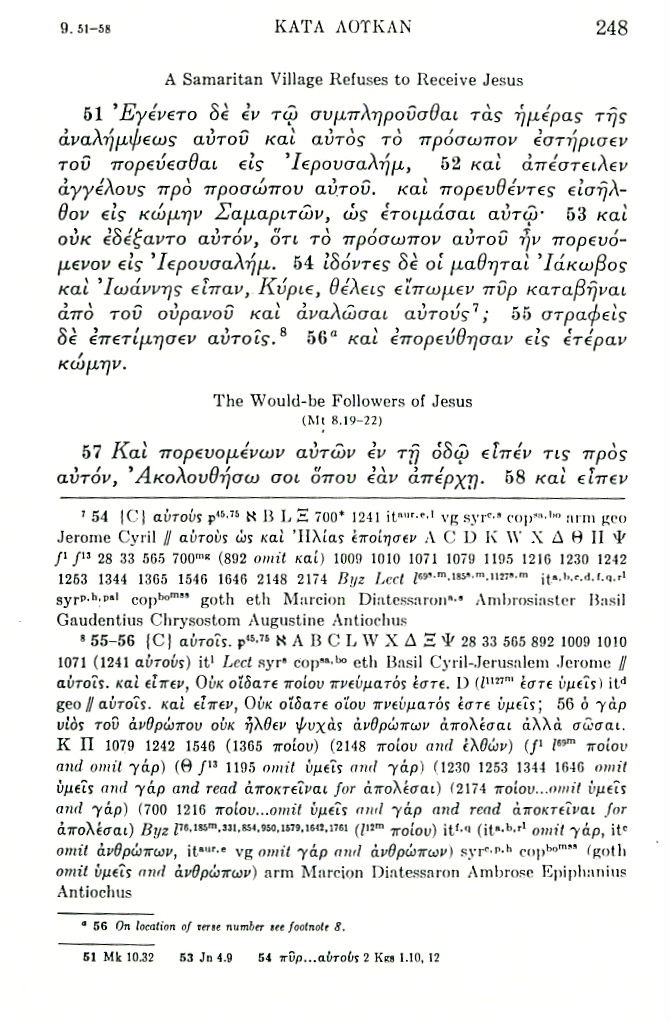
"The Greek New Testament", Kurt Aland, Matthew Black, Carolo M. Martini,
Bruce M. Metzger, and Allen Wikgren, New York:United Bible Societies, 1975.
Further, it is spelled autous and the sentence ends with the words “autous was kai Hlias epoinsen” (“and consume them as Elias did”) in thirty-nine (39) Western or Majority Manuscripts and in thirty-three (33) Lectionaries. This is the same Greek word with two different spellings. Therefore, the predominate spelling is autous in the majority of the Greek manuscripts with the phrase “and consume them as Elias did?” However, other Western Greek texts read autous ws kai Hlias epoinsen (as Elias did?) and this reading is found in manuscripts designated as A, C, D, K, W, etc, for a total of thirty-one (31) manuscripts plus twenty six (26) non-biblical manuscripts. It even shows that manuscript 892 omits the word kai [and] which is a minor detail.
Now let us look at the verse in English and see what this means. The verse in our English King James Bible based on the Textus Receptus or Majority text reads,
"And when his disciples James and John saw this, they said, Lord, wilt thou that we command fire to come down from heaven, and consume them, even as Elias did?" (Luke 9:54) (KJB)
In the New International Version (NIV), the verse is translated “When the disciples James and John saw this, they asked, “Lord, do you want us to call fire down from heaven to destroy them?” (Luke 9:54)
What is interesting and revealing is that the United Bible Society chose to ignore the predominate reading of the Greek text and changed the spelling and omitted the ending phrase.
The phrase "even as Elias did?” is found in over 50 ancient manuscripts compared to only 16 manuscripts the where text ends with the word "them" and omits "even as Elias did?" Plainly, some scribe omitted the statement "even as Elias did" when copying from a manuscript that had that reading. There is no doctrinal problem whether the phrase was in the original or not because clearly as 2 Kings 1:12-14 states Elijah did bring fire down from heaven. Even though the modern versions of the New Testament change based its text on the minority of the Greek texts, no doctrinal teaching of the Bible is affected. The KJB accurately translates the verse and nothing is lost because the Bible records what happened. More importantly, we have the fifty manuscripts with which to compare the variant reading to determine the phrase was in the original autographs and this an accurate translation.
Clearly, anyone who states that our modern Bible does not reflect the original manuscripts and that it has been changed, or parts lost or mistranslated shows their ignorance of the facts. We have the proof in the form of these manuscripts by which we can compare ancient texts and modern translations. The text of the original is clearly known and every variant reading or difference between extant manuscripts has been thoroughly studied and documented. I think it is revealing that this knowledge is widely known. Hundreds of scholarly research books and papers have been written that plainly show the indisputable evidence. Why then to some willingly ignore the truth and teach the lie that our KJB cannot be trusted.
The truth is that those who claim the Bible has not been correctly translated are in gross error. God has preserved His word to us, and nothing has been lost or changed. The manuscripts of the Majority text on which our King James Bible has been translated, has very few differences and not one of the variant readings deals with any doctrinal teaching. The majority of the variant readings only involve the spelling of words and punctuation.
The bottom line is that our modern King James English Bible is shown by the evidence to be an accurate and complete translation of the extant (existing) manuscripts. The one who reads its text can be assured that it is accurate, complete, and trustworthy and is the very word of God.
The Church of Jesus Christ of Latter Day Saints in teaching that the Bible cannot be trusted is incorrect and is based on their founder's ignorance of the Greek text, history of the Bible, and process on which our English Bible was translated. Further, modern LDS scholars, who are well versed in the matter, are being dishonest by not correcting this gross error made by their founder. By examining the manuscripts we can show that our KJV English Bible is accurate and complete. Further, we can compare LDS teachings what the Bible says and show that the god and teachings of Mormonism is false because it is unbiblical.
Herein then lies the problem. The LDS church's doctrines are clearly contrary to what the Bible teaches and wherefore we can surmise that the Eighth Article of Faith of the LDS church was a deliberate attempt to cast a shadow over the Bible and direct LDS church members to their prophets and scriptures for their religious teachings instead of the Bible. When a curious member of the LDS church examines the Bible and finds the many overwhelming contradictions that exist between what it states and what is Mormon teaching, their leaders can say the Bible cannot be trusted. Article Eight of the LDS church is a clear attempt at distorting God's word and misleading its members into accepting a false Gospel and a false church
"All scripture is given by inspiration of God, and is profitable for doctrine, for reproof, for correction, for instruction in righteousness: That the man of God may be perfect, throughly furnished unto all good works" (2 Tim. 3:16-17).
“For the prophecy came not in old time by the will of man: but holy men of God spake as they were moved by the Holy Ghost.” (2 Peter 1:21)
*"All rights reserved" - This article may not be copied or stored in any form without the written permission of the author. The author gives limited permission for the article to be copied in small quantities for use in classes or Bible studies. Under no circumstances may this article be sold.